Evidence Garden
A private system for recovering, checking and reusing evidence from a nonlinear career.
CVs and job titles are highly compressed. They preserve the official outline of a career while losing much of the work itself: difficult decisions, things built, problems diagnosed, informal responsibilities, contributions inside teams and the reasoning behind an outcome.
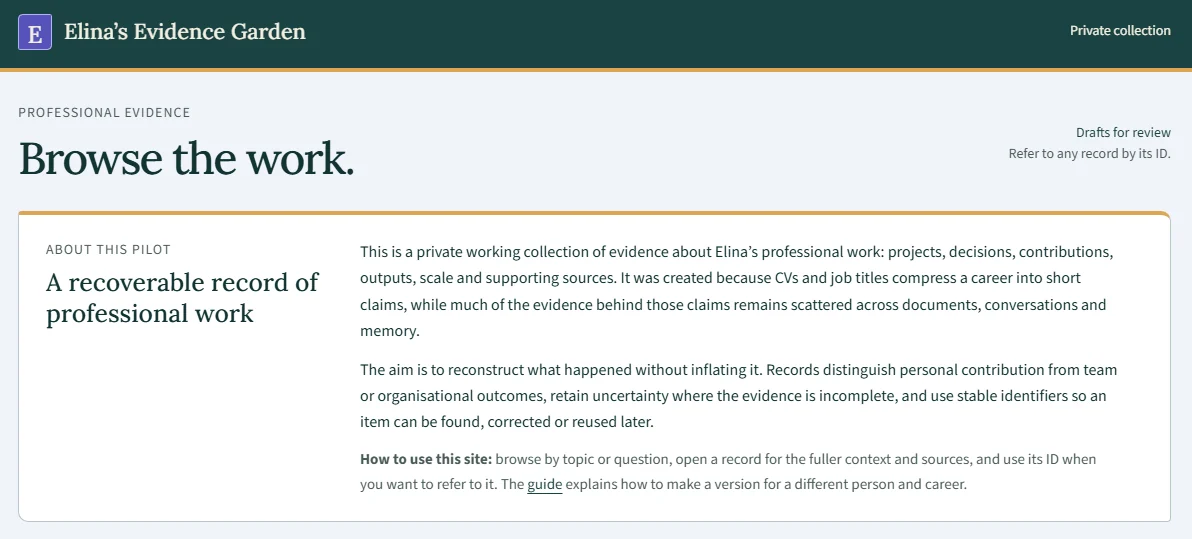
I designed the Evidence Garden to reconstruct that missing layer. It combines structured records, source trails, stable identifiers and an AI-supported interview process. The result is a private collection that can be searched by project, problem or type of contribution, then used selectively for applications, interviews, proposals and portfolio writing.
- Project type
- AI-supported knowledge system and private web application
- My role
- Concept, information architecture, evidence model, editorial criteria, interaction design and iterative build
- Tools used
- ChatGPT, Claude, ChatGPT Sites, Markdown, a private database and a custom ChatGPT plugin
A career can contain far more evidence than its public record suggests
This problem is not limited to people with obvious career gaps. It is common among independent consultants, multipotentialites, people with ADHD, founders, researchers, portfolio workers and anyone whose contribution has crossed formal role boundaries.
Several things make the evidence difficult to recover:
- the same project appears in partial form across old CVs, proposals, presentations and applications;
- important work may have happened inside a team and therefore cannot honestly be claimed as an individual result;
- invisible work such as diagnosis, framing, judgement and negotiation rarely appears in a deliverable;
- people who dislike self-promotion may underdescribe their contribution or fail to record it at all;
- broad labels such as “strategic”, “commercial” or “creative” are difficult to trust without the episodes behind them;
- when a new opportunity appears, the person must reconstruct the relevant evidence from memory under time pressure.
The usual response is to polish the CV again. That changes the summary without repairing the missing evidence underneath it.
The ideaRecover the episodes first. Interpret the patterns later.
The Evidence Garden starts with bounded episodes rather than a predetermined skills framework. Each record describes a particular project, decision, problem or responsibility and distinguishes:
- what was happening;
- the problem or constraint;
- the person’s own contribution;
- how that contribution connected with the wider work;
- outputs, results or other observable traces;
- supporting sources;
- gaps, uncertainty and confidentiality limits.
Only after several records exist does the system suggest recurring capabilities or useful categories. This reduces the temptation to force a varied history into a tidy but generic professional identity.
Every episode and source has a stable identifier. The identifier makes the record easy to retrieve, discuss and correct even when its title or categories change.
How the pilot was made
1Recovering the source material
The first corpus brought together CV versions, job applications, proposals, reports, project documents and earlier Markdown extractions. The aim was not to treat every document as proof. It was to recover candidate episodes and identify where the same work had been described differently over time.
2Extracting bounded episodes
Claude and ChatGPT helped process the material in batches. Broad claims were converted into inspectable units: a specific problem, the surrounding context, an attributed contribution and the available traces of what followed.
Repeated text across documents was used to restore context, not counted as independent confirmation.
3Reviewing attribution and uncertainty
The records were edited to separate individual contribution from team or organisational outcomes. Proposals were not presented as delivered projects. Intended outcomes were not converted into achieved results. Where the evidence was incomplete, the gap remained visible.
4Designing the collection
The first private site supports several ways into the same evidence:
- topic-based browsing;
- practical questions such as how complex evidence was made usable;
- full-text search;
- detailed episode records;
- a source register;
- recovered leads that are not yet complete enough to become records.
The front page stays compact. Stable IDs appear when a record is opened, where they are useful for reference and correction.
5Connecting the garden to ChatGPT
The site exposes a small set of authenticated tools through a private plugin. From an ordinary ChatGPT conversation, the owner can:
- add a candidate evidence record;
- retrieve a record by its stable ID;
- search records by project, phrase, source or possible capability.
Visitors may be given read access to the site, but only the owner can add records through the plugin. This keeps collection and review close to the conversations in which useful evidence often resurfaces.
What AI contributed, and what remained human work
AI made it feasible to process a dispersed archive, compare repeated accounts, draft structured records and implement a working interface without first turning the project into a conventional software-development exercise.
The consequential decisions remained human:
- defining what counted as evidence;
- deciding how cautious the claims needed to be;
- correcting false attribution and suspiciously neat causal stories;
- recognising which distinctions mattered;
- choosing what could remain private and what might eventually be made public;
- judging whether the emerging categories described the person or merely the available documents.
The project is therefore also an example of human–AI collaboration as design work. The value did not come from asking AI to produce a portfolio. It came from constructing a process in which AI could help recover, organise and test evidence without becoming the authority on what the career meant.
What the pilot produced
The pilot currently includes:
- structured records of professional episodes;
- a linked source register;
- incomplete leads preserved for later investigation;
- question-led and topic-led retrieval;
- stable references for discussing individual records;
- a private site that can be shared with selected reviewers;
- a connected ChatGPT plugin for adding, finding and retrieving records.
It remains a review system, not a public claim that every record is complete or approved.
Why the approach may be useful beyond this project
The underlying problem is widespread. Professional systems usually ask people to present conclusions about themselves before they have assembled the evidence from which those conclusions could reasonably be drawn.
An evidence garden offers a different sequence:
- recover specific episodes;
- inspect the traces and uncertainty;
- notice patterns across several episodes;
- assemble a version appropriate to a particular audience.
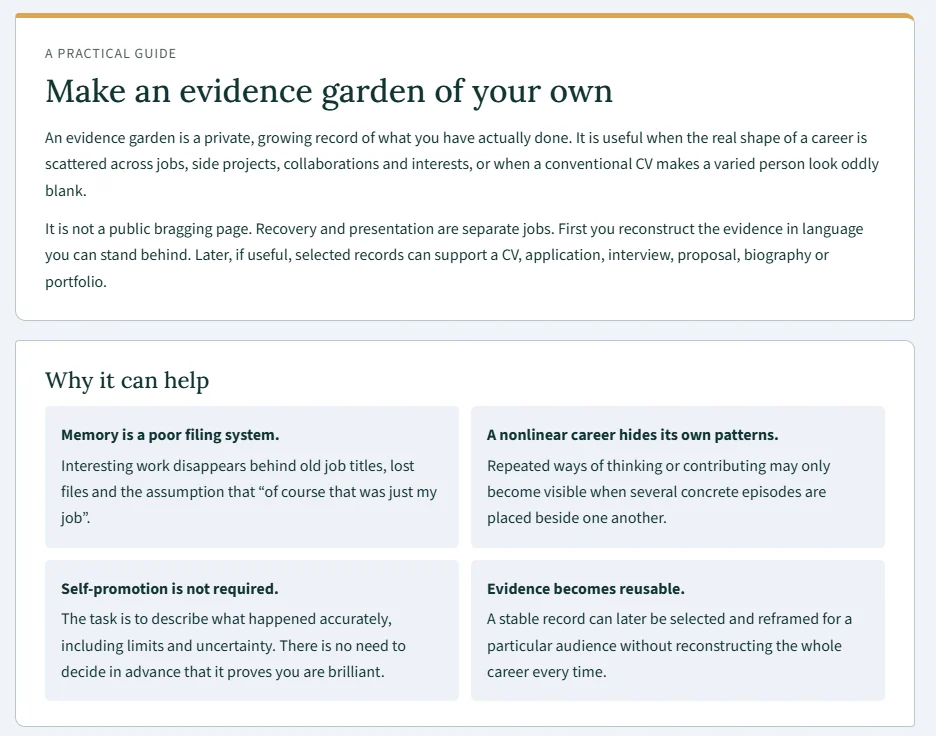
The method can be useful without a website or plugin. A collection can start in Markdown, a spreadsheet or a notes system. The important part is the separation between private evidence recovery and public presentation.
Downloadable guides
-
How to build a personal evidence garden
Purpose, principles and the overall process.
-
Run the evidence-recovery conversation
How to set up a dedicated ChatGPT conversation and conduct the interview in manageable stages.
-
Design the records and source register
A reusable record model, confidence rules and stable-ID conventions.
-
Connect an evidence garden to ChatGPT
What the plugin does, recommended permissions and the tools it should expose.
-
Create an optional private site
How to turn the records into a private, browsable review interface without making the underlying evidence public.
These are working guides, not a claim that one technical setup will suit everyone. The garden can remain a set of well-structured files if that is the useful form.
The aim is not to make every career look coherent
Some histories are genuinely varied. Some projects ended. Some skills were used intensely and then set aside. A useful evidence system should not erase that complexity merely to produce a cleaner professional story.
The Evidence Garden creates enough structure to recover what happened and enough flexibility to let different patterns emerge. It gives the person something more reliable than memory and something richer than a list of claims.