Agentic Systems Reading Room
A research triage system for staying oriented in a fast-moving field without pretending I will read everything.
New research on agentic AI appears continually. Weekly scheduled research sweeps bring me papers and reports on human–AI collaboration and adoption, while social media supplies a less orderly stream of everything else. I cannot read all of it closely, and I do not need engineering-level understanding of every paper. I built the Reading Room to assess what new material is, preserve why it may matter and find it again when a later question justifies deeper attention.
Behavioural diagnosis
Research on agentic AI arrives faster than any one person can sensibly read it. My weekly scheduled research sweeps continually surface work on human–AI collaboration and AI adoption. Papers, reports and commentary also appear through social media, citations and ordinary browsing. The pile is not going to become smaller through exemplary personal discipline. It is designed to keep accumulating.
This creates both overwhelm and research FOMO. A new paper might contain something that matters to my work, but I often cannot know that until a later question gives it context. Reading everything immediately would consume time without producing proportionate value. Saving an unannotated link avoids the immediate decision but usually turns the paper into part of an inaccessible backlog.
The useful alternative is triage. I need enough contact with a source to understand what kind of contribution it makes, whether it is likely to matter and what would justify returning to it. That initial assessment is not a substitute for close reading. It is a decision about the appropriate depth of attention now, combined with a route back later.
The cumulative effect matters. If each source leaves behind a bounded, retrievable record, future work can start from earlier orientation rather than reconstructing it. The Reading Room turns a stream of new material into an accumulating research resource.
From barrier to design response
| Observed problem | Underlying barrier | Design response |
|---|---|---|
| New research arrives every week from several directions | The inflow continues regardless of how much I have already read | Provide a low-cost triage route so new material can be assessed without becoming an immediate deep-reading obligation |
| Every new paper carries a small possibility of being important later | Its relevance may only become visible when another question, source or project appears | Preserve a bounded record of its subject, contribution and possible relevance so it can be recognised and retrieved later |
| Reading everything closely is impossible and unnecessary for my role | Different sources warrant different depths of technical and methodological attention | Separate initial orientation from later close reading instead of treating a paper as simply read or unread |
| Saved links accumulate without accumulating understanding | A bookmark preserves a location but not what attracted attention or how the source might connect to existing work | Store papers, reports and books alongside notes, concepts, glossary entries, questions and methods |
| Agentic-systems research uses broad and unstable labels | Apparently similar papers may describe systems with materially different capacities, environments and patterns of direction | Develop a design taxonomy that offers a shared structure for comparing configurations without assuming that one label identifies one kind of system |
What I built
I built a working research notebook for triaging and gradually understanding agentic-systems research. It distinguishes external material such as papers, reports and books from the conceptual material developed while working with them: concepts, notes, glossary entries, open questions and methods.
The Reading Room supports several depths of engagement. A source can be recorded because I need to remain aware of it, annotated enough to explain why it may be useful, or revisited for closer reading when it becomes relevant to a specific question. Search and the different record types provide routes back into the material.
The system is primarily for me. Public access makes the research trail inspectable and may be useful to other people, but it does not turn the collection into a claim of completeness. The Room reflects my questions, my level of technical engagement and the decisions I have made about where deeper scrutiny is worthwhile.
Alongside it, I built the Agentic Systems Design Taxonomy, a public demonstrator of the design taxonomy that developed from my thesis. The Design Taxonomy and the Reading Room are related but not duplicates. One supports ongoing research work; the other makes a conceptual argument visible.
How it works
- Research enters from several streams. Weekly scheduled sweeps surface work on human–AI collaboration and adoption. Social media, citations and ordinary browsing add further papers, reports and commentary.
- I establish what the item is. AI can help identify the topic, type of contribution, central claim and likely relationship to my existing questions. This is orientation, not a declaration that the source has been fully evaluated.
- I decide how much attention it warrants now. Some material needs immediate scrutiny. Some only needs a useful record. Some does not belong in the collection at all.
- I preserve enough for later recognition. The record keeps the source findable and explains why it may matter, rather than storing only a title and URL.
- Conceptual work accumulates alongside the sources. Notes, glossary entries, questions and methods preserve the distinctions and uncertainties that develop across multiple readings.
- I return when a real question creates relevance. Search and structured record types let later work start with what I already established, while the original source remains available for the closer reading the new question requires.
The scheduled sweeps do not automatically populate the Reading Room. They create a regular incoming stream. Selection, interpretation and the decision to preserve or revisit something remain mine.
Important design choices
| Design choice | What it needed to solve | What I built |
|---|---|---|
| Design for continuing inflow | Continuing discovery means the queue will keep replenishing itself | A triage workflow that treats recurring arrival as normal rather than waiting for the backlog to be “finished” |
| Separate orientation from close reading | A binary read-or-ignore model makes every potentially relevant paper feel like an immediate obligation | Records can preserve what a source appears to contribute and why it may matter without pretending that preliminary orientation equals full appraisal |
| Preserve the reason for saving | Titles and URLs rarely explain why a source seemed relevant several months later | Source records retain enough annotation and context to support a future decision about whether deeper reading is worthwhile |
| Keep research objects distinct | Sources, developing concepts and methodological questions play different roles in a research programme | The Room has separate areas for Papers, Reports and Books, Concepts, Notes, Glossary, Questions and Methods |
| Make a private working function publicly inspectable | Public presentation can encourage artificial completeness and polish | The Room remains visibly a working notebook shaped by my questions, while being publicly readable for anyone who finds the trail useful |
| Keep the live system separate from the conceptual demonstrator | A research workflow and a thesis argument should not be presented as though they perform the same job | The Reading Room supports ongoing triage; the Design Taxonomy site demonstrates the model and one possible use for organising research |
The Agentic Systems Design Taxonomy
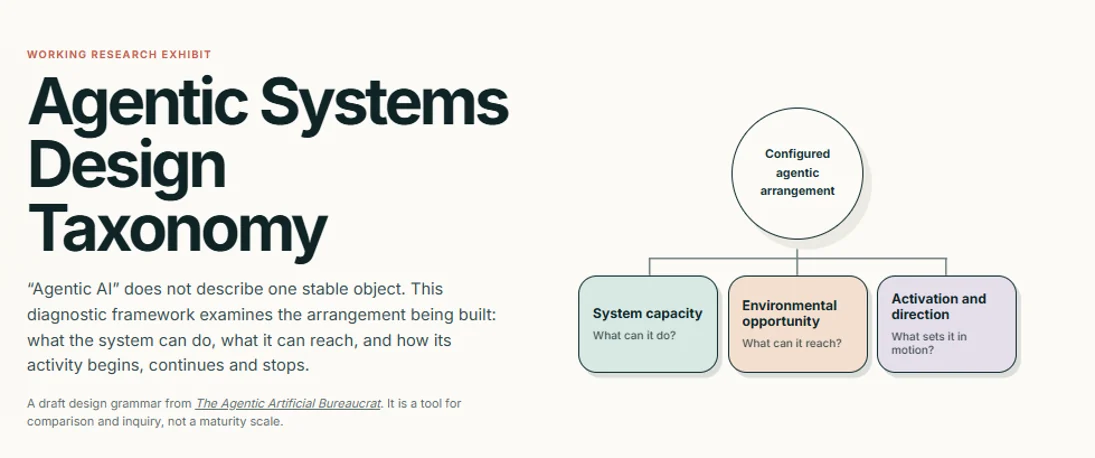
The Design Taxonomy started as a demonstration of the central idea developed through my thesis. “Agentic AI” covers systems with very different arrangements. Rather than asking only whether something is an agent, the taxonomy describes its configuration across three domains:
- System capacity: what the system can process, plan, remember, execute, revise or coordinate.
- Environmental opportunity: what information, tools, permissions, infrastructure and organisational processes are available to it.
- Activation and direction: how work starts, where objectives come from, how initiative and delegation operate, and how continuation or return of control is handled.
The Design Taxonomy site makes that model visible and explorable. The research section at the end demonstrates a further possibility: the taxonomy could help organise literature by the aspects of agentic systems that each source examines. That may eventually support the Reading Room, but it is currently a conceptual demonstration rather than an automated or comprehensive research pipeline.
I’ve written more about this in Designing agentic systems.
View the Agentic Systems Design Taxonomy (opens in a new tab)
How I worked with AI
AI makes the early stages of research triage much cheaper. It can help inspect a newly surfaced paper or report, identify its apparent focus, prepare a bounded description, suggest relevant concepts and make the resulting record searchable. Scheduled research sweeps also extend what I encounter beyond the sources I happen to see in my own feeds.
Those functions do not remove the distinction between orientation and evidence appraisal. I decide whether a source matters, what depth of reading the question requires and whether the generated account represents the source fairly. When a claim becomes consequential to my analysis, the original material must be examined rather than replaced by a fluent summary.
I also used AI to turn an evolving information model and a thesis taxonomy into two working public artefacts. Rapid implementation made it possible to test whether the categories, navigation and visual representation actually supported the research task, then revise the design while the reasoning remained fresh.
What this project demonstrates
Capabilities applied
| Capability | Evidence in this project |
|---|---|
| Behavioural diagnosis | I identified that research FOMO was being sustained by a false choice between reading every potentially relevant paper closely and losing it in an uninformative backlog. The design introduces proportionate attention as a third option. |
| Research triage | Weekly scheduled sweeps and social-media discovery create a continuing intake. The Reading Room separates preliminary orientation, selective preservation and later close reading rather than giving every source the same treatment. |
| Information architecture | Papers, Reports and Books remain distinct from Concepts, Notes, Glossary, Questions and Methods, so external evidence and the structures developed around it can accumulate together without becoming interchangeable. |
| Conceptual modelling | The Design Taxonomy site translates the thesis argument into a three-domain taxonomy covering system capacity, environmental opportunity, and activation and direction, with more detailed dimensions beneath each. |
| Iterative AI prototyping | I used AI to turn both a research workflow and an abstract taxonomy into public, testable artefacts. The Design Taxonomy site’s research section then tests a secondary use for the taxonomy without claiming that it is already the Reading Room’s operating structure. |
Capabilities extended
The project is extending my ability to design proportionate research workflows: deciding what needs awareness, what needs preservation and what needs genuine close reading. It is also developing the relationship between evidence management and conceptual modelling. A taxonomy can provide useful orientation across a literature, but only if it remains open to papers that complicate or expose gaps in the model.
What I learned
Triage is not failed reading. It is a decision about how much attention a source warrants for the purpose at hand. That decision can remain revisable if enough context is preserved.
The cumulative value comes from leaving a usable trace. A single annotation may be modest, but a collection of recoverable judgements changes the starting point of future work. The goal is not to defeat the pile. The pile has scheduled reinforcements. The goal is to make contact with it accumulate into something more useful than anxiety and browser tabs.