BusyDoggie Fieldnotes
An evidence-aware working notebook for questions about dogs.
BusyDoggie Fieldnotes gives canine research, close observation and developing ideas a useful public form before they become finished articles, if they ever do. It keeps each fieldnote available to revisit and extend while preserving what kind of knowledge it contains, how far the evidence reaches and where an interesting idea remains a hypothesis rather than advice.
Behavioural diagnosis
Writing a properly developed BusyDoggie article takes time. It is also not my main job, so even good ideas are reasonably deprioritised behind paid work and other responsibilities. There can be a long delay between developing an idea and publishing an article about it. During that interval, the idea may keep changing as I find new research, notice something in the dogs or make a better distinction.
The available formats created an awkward choice: leave that thinking buried in conversations and research notes, or force it prematurely into a finished article. The first loses useful work. The second asks for time and closure that the idea may not yet warrant.
There is a second problem specific to the subject. People who live and work with dogs encounter knowledge from many directions: scientific papers, veterinary and training professionals, breed communities, social media, their own dogs and other owners’ experience. These forms of knowledge are easily flattened as they move into practical discussion.
A study can acquire a much broader meaning than its design supports. An observation from one dog can become a general rule. A plausible mechanism can quietly turn into an explanation. At the other extreme, lived observation may be dismissed because it is not controlled research, even when it identifies a pattern or question worth investigating.
The system therefore needed to bridge an editorial delay without pretending that every fieldnote is a future article. A note can become publicly useful now, remain open to revision and later contribute to a longer post if the subject warrants it.
From barrier to design response
| Observed problem | Underlying barrier | Design response |
|---|---|---|
| A developed idea may wait months before I can write a full post | Long-form canine writing is time-consuming and must compete with paid work and other priorities | Give the idea a smaller public form that is worthwhile in its own right |
| The thinking continues to change during that delay | A conventional article implies a settled account at one point in time | Use revisable, linkable fieldnotes that can accumulate evidence and distinctions before any final piece exists |
| Research, professional guidance and personal observation circulate together as “dog knowledge” | Their different origins and evidential status disappear in ordinary discussion | Record sources, observations and interpretations separately, with visible provenance |
| A study is repeated as a general rule | Sample, method, comparison and limitations are lost when the finding is summarised for practical use | Annotate sources with what was studied, what was found and what the design cannot establish |
| A striking observation either disappears or becomes overgeneralised | There is no comfortable category between anecdote and established finding | Preserve observations as observations and use them to generate more precise questions or working hypotheses |
| Plausible mechanisms sound more certain once written neatly | Explanatory language can outrun the available evidence | Keep qualifiers, alternative explanations and evidence gaps inside the saved record |
| Potentially useful material is scattered across papers and long conversations | Recovering and classifying it later requires a separate administrative workflow | Capture from conversation, use AI-assisted tagging and connect related sources and notes |
What I built
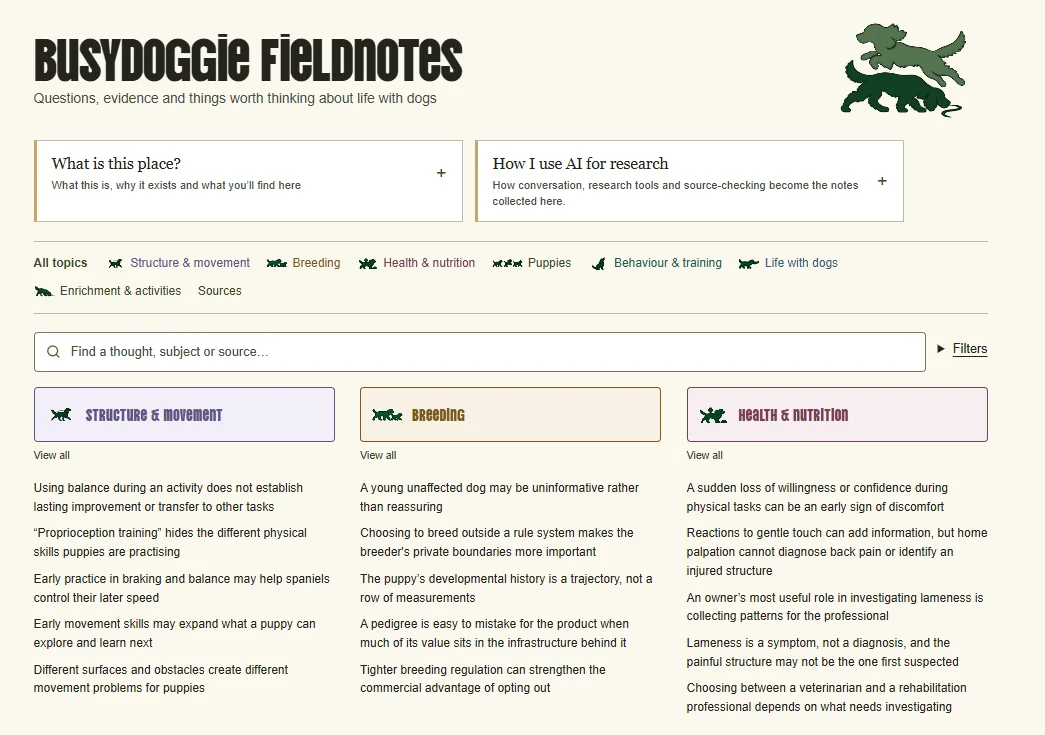
I built a public working collection for canine inquiry and developing BusyDoggie writing. It combines structured source records with short notes containing observations, evidence distinctions, practical questions and working hypotheses. Each item can retain provenance, uncertainty, detailed tags and connections to related material.
The system is designed for the long space between developing an idea and having the time and evidence to publish a finished article. A fieldnote makes the thinking available without committing me to producing that article. If the idea develops further, the existing record gives me something structured to return to rather than requiring me to reconstruct the entire line of thought.
A source annotation can preserve the population, method, result and important limitations of a study. A separate note can record what the study suggests for a practical question without attributing that interpretation to the researchers. An observation from living with or breeding dogs can be kept without presenting it as a universal claim.
Within the collection, short pieces of thinking are called Pebbles and external papers, reports and other materials are stored as Sources. The terminology is shared with InfoMagpie’s Nest, but the editorial model is more domain-specific: evidence status, transfer to practice and proportionality of claims matter throughout.
The material currently spans subjects including puppy development, movement and lameness, scent work, dog–human relationships, behaviour, health and breeding. The collection is useful to me as a breeder, dog owner and canine writer, and publicly readable by anyone interested in how the questions develop.
How it works
- Start with a real question. It may arise from a dog’s behaviour, a breeding or training decision, a paper, a professional claim or something difficult to explain precisely.
- Inspect the available evidence. Research sources are read for their actual population, methods, comparisons and limits, rather than reduced to the most appealing conclusion.
- Record the source on its own terms. The source entry preserves bibliographic information and a bounded account of what the material supports.
- Develop the practical thinking separately. Observations, distinctions and hypotheses become their own records, with attribution and qualifiers intact.
- Add structure without turning it into another filing job. AI helps prepare self-contained wording, propose useful tags and identify relevant connections. I select, revise and decide what belongs in the public collection.
- Retrieve and develop it later. Search, subjects, tags and links bring earlier questions and evidence back into later conversations, practical decisions and, where appropriate, fuller BusyDoggie posts.
Not every question ends in a conclusion. A record can establish that two things are distinct, that an appealing claim lacks evidence, or that an observation has generated a better question.
Important design choices
| Design choice | What it needed to solve | What I built |
|---|---|---|
| Preserve epistemic status | Research findings, observations and hypotheses are useful in different ways | I separated external Sources from interpretive Pebbles, while the wording and provenance show whether a record contains a finding, observation, question or working hypothesis |
| Keep claims proportional to the evidence | Practical enthusiasm can turn association, analogy or mechanism into a stronger conclusion | A fieldnote about balance work, for example, distinguishes using balance during an activity from evidence of lasting improvement or transfer to other tasks |
| Treat observation as a starting point for inquiry | Close observation can reveal patterns worth investigating without proving them | Notes about matters such as the timing of lameness preserve the observation as evidence that can narrow a question, not as a diagnosis |
| Separate source summary from practical interpretation | A useful inference may be mine even when a paper prompted it | Source annotations retain details such as sample and population limits; any practical interpretation prompted by the paper can become a separate linked Pebble |
| Create a useful stage before the article | The time required for a full post creates a long gap between developing an idea and sharing it | I can publish a bounded fieldnote about puppy development, movement or scent work now, revise it as the thinking develops and later use it in a fuller post without promising that I will |
| Organise around later use | A large archive has little value if material cannot re-enter a practical question | Searchable text, AI-assisted tags and direct links reconnect related notes and sources across subjects such as movement, proprioception and lameness |
How I worked with AI
AI helps me move between several forms of work that would otherwise become separate projects: searching and reading research, interrogating claims, comparing sources, articulating observations, identifying the exact point of uncertainty, generating tags and implementing the public collection and its conversational tools.
My role is to decide what question matters, scrutinise whether the account matches the source, separate finding from inference, preserve relevant qualifications and judge what can responsibly be made public. I also designed the record structure, retrieval routes and editorial rules and tested how well they survive actual use.
This arrangement makes a particular kind of collaboration possible. AI can help elaborate an observation and search for relevant concepts without requiring the observation to become true by virtue of receiving a scientific vocabulary. It can help compress a paper while the system still preserves the information needed to resist an overconfident summary.
What this project demonstrates
Capabilities applied
| Capability | Evidence in this project |
|---|---|
| Behavioural diagnosis | I identified two connected failures: developed ideas could wait months for a full article, while movement between research and everyday dog practice stripped claims of evidential status. My notes on recent copper toxicosis research, for example, can be useful in public now, even though the full article is not yet a priority. |
| Evidence synthesis | Source records retain study design, sample boundaries, findings and limitations. The maternal-care annotation records that the 59 litters came from one US service-dog organisation, rearing location was not randomly assigned and the observed effects were mixed. |
| Information architecture | The 59-litter maternal-care paper is stored as a Source with its methods and population limits, while the balance-transfer and lameness-timing pieces are Pebbles with their interpretive provenance preserved. The record types keep those materials distinct without requiring them to live in separate archives. |
| Research translation | The balance-work fieldnote makes the inferential boundary explicit: performing an activity successfully is not evidence of lasting improvement or transfer to other tasks. |
| Editorial judgement | The note about early braking and balance labels its possible injury-prevention relevance as a rationale to investigate, not an established result; the lameness note refuses to turn timing patterns into simplistic tissue diagnoses. |
Capabilities extended
The project is extending my experience of building evidence-aware knowledge systems and applying research appraisal across a highly interdisciplinary field. It has also developed my practical use of conversational tools for moving between observation, literature search, critical reading and public knowledge capture.
What I learned
Publication does not have to be a jump from private notes to finished article. A smaller public form can be useful without becoming a promise to write the larger piece, and it can reduce the work of returning to an idea months later.
Rigour does not require excluding observations or developing ideas. It requires preserving what they are. An owner’s observation, a controlled study and a mechanism inferred in conversation can all contribute to inquiry once their roles are visible. The collection is most useful when it helps an interesting claim become a better question before it becomes advice.