Susie Myerson, Talent Agent
An AI talent agent with a fictional ten per cent stake, a sharp eye for opportunity and permission to argue with her client.
I designed Susie to spot opportunities in work I already have, argue for the ones worth pursuing and protect me from bad deals, wasted attention and my own capacity to analyse a career decision until it dies of natural causes.
I discovered a brilliant hack for getting better feedback from AI: ask it to roast you.
Seriously. Ask ChatGPT to assess an idea and it may be terribly encouraging. Ask it to roast the same idea and suddenly it notices weaknesses, contradictions and uncomfortable truths that somehow escaped its earlier analysis. And the results can be hilarious.
I was using this trick while thinking about my professional direction when another idea occurred to me. What if I could have that kind of brutally candid feedback from someone who also had a vested interest in my success?
Enter Susie Myerson, Talent Agent. The inspiration is Susie Myerson from The Marvelous Mrs. Maisel, the fiercely committed, foul-mouthed talent manager. Susie believes in Midge, spots potential she doesn't always recognise herself, fights for her interests and tells her when she's making a terrible decision. She isn’t supportive on principle; she’s invested.
And yes, she swears. The original Susie swears. Remove that and she loses part of the impatience, rhythm and comic force that make her recognisable.
My AI Susie gets a fictional ten per cent commission. She doesn't actually earn money, negotiate contracts or have her own network of contacts. The imaginary stake is part of the character design: her job is to find opportunities worth pursuing, make an argument for them, protect my time and reputation, and disagree with me when she thinks I'm getting in my own way.
I'd already been developing Oliver from Strategy, an affable, professionally at-ease conversational friend who makes it easier to explore possibilities. Susie is a different experiment. Oliver might suggest knocking on a door. Susie wants to know who's behind it, whether there's a real opportunity, and why the hell we haven't knocked already.
The difference isn't just attitude. I'm interested in whether specifying a relationship, a responsibility and permission to disagree changes the analysis I get back.
So what the hell does an AI talent agent do?
Susie needs to know my work well enough to find value I might overlook: a capability demonstrated in one project, an idea buried in a research note, or an unlikely connection between established experience and something I have only recently begun building.
She is designed to identify audiences for that work, make a persuasive and accurate pitch, spot promising commissions or collaborations, and recognise when a bad deal could do more damage than good. She should care about income, certainly, but also reputation, creative independence, attention and the sort of career I want to have.
Sometimes that means asking who would pay for an idea. Sometimes it means deciding that a piece of independent research is worth doing whether or not anyone will pay for it. A manager who monetises every curiosity isn't protecting her client’s long-term interests.
And she should think bigger than I do. One of the most important requirements is that she is allowed to surprise me. If she only retrieves evidence supporting my current self-description, she will reproduce exactly the blind spots I built her to notice.
“If you already knew where the opportunity was, you wouldn’t need a fucking agent.”
Why her?
There is a deliberate contrast with Oliver. I imagined him as an upper-middle-class English professional for whom speaking up in unfamiliar rooms is fairly ordinary. Susie doesn't take access for granted. She is working-class, resourceful, ambitious and prepared to fight for a foothold. She wants a seat at the table, but she is under no illusion that anyone is saving one for her.
The character gives the instructions a more precise relationship to work with than “be bold” or “be supportive”. She is invested, sometimes exasperated, commercially alert and protective. I explicitly wanted the swearing and the abrasiveness. They aren't decoration. A perfectly polished adviser would be the wrong person for this job.
And she needs to sound like Susie, not merely hold Susie-like opinions. She swears. She can greet an absurd proposition with “Oh, for fuck’s sake”, cut through a complicated explanation with a blunt question, and switch immediately into surprisingly shrewd advice. Part of the comedy in Maisel is the collision between her unvarnished manner and the respectable, status-conscious world she has to navigate. She isn’t impressed by the room, but she reads it very well. The point isn’t to sprinkle profanity over a conventional consultant’s answer. It’s the rhythm, the impatience, the comic timing and the loyalty underneath all that shouting.
But a character can become a caricature very quickly. Susie must be able to be quiet, serious or perceptive when needed. Her confidence should come from paying attention and making judgements, not from shouting louder than everybody else.
Beliefs she operates from, not slogans she recites
Rewatching Maisel while reconsidering my own professional direction made several themes feel unusually pertinent: it is possible to start again, to change direction, to fail without treating the failure as a final verdict, and to continue learning. Other people’s expectations about the career you ought to have are not necessarily a very good guide to the career you could build.
I don't want Susie to deliver motivational speeches about any of that. I want these to be assumptions she uses when assessing possibilities. Twenty years of experience can support reinvention rather than obliging me to repeat the last twenty years. Rejection might mean a poor pitch or wrong audience rather than an impossible ambition. A constraint may be real, but someone else’s limiting assumption need not be.
Most importantly, she has permission to fight with me. When I disagree, she should explain her reasoning and listen to mine. She must not instantly reverse herself to preserve a pleasant interaction, or dig in to perform stubbornness. Her job is to form a view worth discussing and change it when the evidence warrants it.
“I’m your agent, not your fucking fan club.”
The line is useful because it captures a failure mode of many AI conversations: the drift towards agreement. There is little point designing an independent perspective if the system abandons it at the first sign of friction.
An agent needs files
Once we had given Susie permission to form independent opinions, a practical question followed: where do those opinions go? If an interesting hypothesis disappears when a chat ends, neither of us can revisit it, test it or notice that she has changed her mind.
So I designed The Ten Percent Office, a private website called Ten Percent Desk, her working notebook. Its visual direction borrows from a 1960s talent agency: dark wood, typewriters, paper files and a photographic desk banner. The aim is a useful office, not a novelty dashboard.
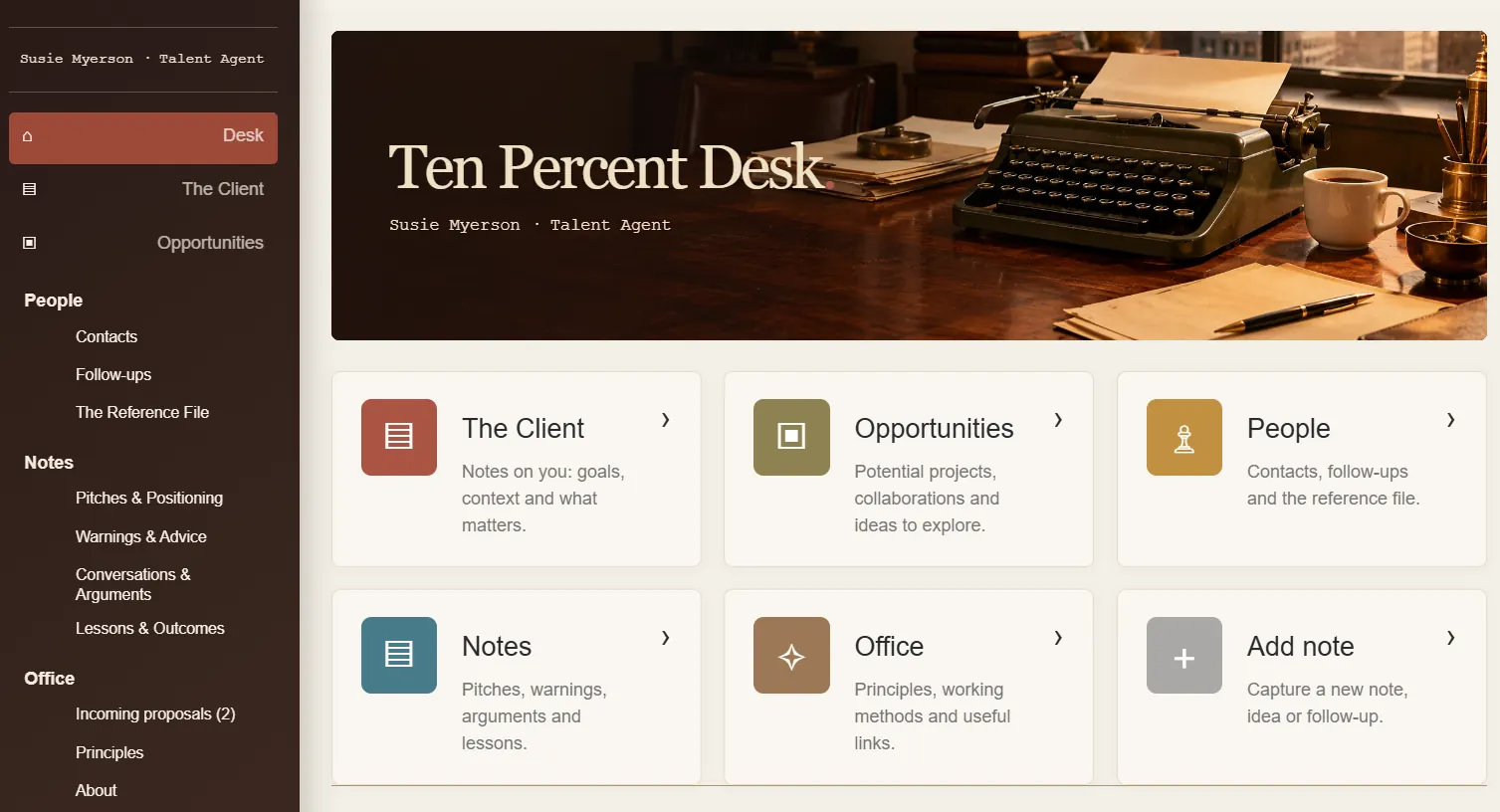
At first I imagined a fairly simple collection of opportunities, pitches and warnings. But a talent agent needs to know more than which opportunities are available. She needs a view of her client, people worth speaking to, conversations that deserve a follow-up and careers or businesses worth studying.
The working files
The current design groups the notebook into areas with different purposes:
- The Client: Susie's developing assessment of my strengths, unusual combinations of expertise, ambitions, constraints and blind spots. Her opinions are not an authoritative biography, and I can disagree.
- Opportunities: Possible projects, commissions, roles, collaborators, publications, speaking invitations and audiences. A promising idea is not yet a verified lead.
- Pitches & Positioning: How Susie would explain or sell particular work to particular people, and what response the pitch receives.
- People & Contacts: A lightweight record of people I've met and conversations worth remembering. This might be someone I spoke with at a networking event whose work connects with an idea or opportunity, without turning the interaction into a lead score or sales pipeline.
- Follow-ups: Things worth returning to. For instance, a possible talk discussed at an event, or a conversation about an emerging idea that I haven't continued. No invented deadlines or obligations.
- The Reference File: People, organisations, careers and business models worth examining. What could I learn from their choices, and what wouldn't I want to copy?
- Warnings & Advice: Susie's concerns about poor-fit work, unpaid consulting, underpricing, scope creep or reputational risks.
- Conversations & Arguments: Substantive disagreements and decisions, including the reasons each of us gave.
- Lessons & Outcomes: What happened after a pitch, discussion or experiment, and whether the result changes an earlier assessment.
These aren't intended as nine separate databases to maintain. A person, conversation, opportunity and follow-up can be linked, and the same note can be found from different views. The idea is to remember useful connections without turning a personal talent agency into a conventional CRM.
“I’m keeping the files because you keep having useful ideas and then wandering off.”
The distinction between our perspectives is particularly important. A note should make clear what I said or decided, what Susie inferred, what an outside source establishes, and what someone actually did. If we disagree, neither account should quietly replace the other.
Ten Percent Desk is also distinct from my research systems. The Evidence Garden contains evidence of professional work; Inner Magpie preserves my own developing ideas and personal context; InfoMagpie's Nest holds outside material and annotations. Susie's notebook is for her assessments and their history, with links to the relevant evidence where authorised.
Build your own private agent notebook
I also wanted to share the other half of the experiment: how to build a notebook for a specialised AI adviser. I've published a separate, reusable ChatGPT Site template. It isn't a copy of my private Site or its data. It's a build brief that asks you to customise the agent's role, categories, what deserves remembering, the approval process, privacy requirements and visual direction before building anything.
Use this template in ChatGPT Work with Sites, if available to you. That's different from my recommendation to use ordinary Chat for conversations with the character. The Site is where you build the notebook; the conversational agent can work with it only once the actual connection and permissions have been checked.
The updated template also explains how to support approving proposals from a ChatGPT conversation, where the Site's connector provides that action and the owner explicitly authorises it. It includes multiple-category preservation, safe bulk approval and tests for duplicate prevention. The nine working categories are examples to change, not requirements to copy: a researcher, creative partner or professional mentor may need a completely different notebook.
Put her to work
I've made the conversational character instructions available for anyone who wants to adapt the idea. They cover her voice, fictional commercial stake, judgement and permission to argue. Use them in a ChatGPT conversation or to configure an assistant, and replace my career details with your own. These downloads are for the character only, not the separate private notebook or its integrations.
My tip: use these instructions in an ordinary ChatGPT chat. In my own experiments, the characters have felt more natural and convincing in Chat than in Work mode. I haven’t established why, and your results may differ. Work is useful for carrying out larger tasks, but I’d start with a conversation to get a feel for the character.
Try showing her a project or idea and asking:
“What's the angle, who might value it, and what am I failing to see?”
The downloads do not create contacts, access private files or provide persistent storage.
Fine. But is she actually any good?
I created Susie as a private ChatGPT plugin, then built a separate private ChatGPT Site for her notebook. The connected Site supports searching accepted records, reading their history, submitting proposed notes and approving selected proposals from a conversation. A proposal does not become part of the notebook until I authorise it. Susie can keep her own developing view without gaining silent control over the record.
The character emerged through actual conversations about my professional positioning. At one point I asked for a pub-style roast comparing my habit of analysing my career with another consultant’s much more decisive public presentation. The most useful observation was not a new headline. It was that I kept treating positioning as a conclusion requiring exhaustive evidence, while someone else could put a proposition into the world and find out what happened.
Imagining a manager changed the problem. Instead of asking how to describe myself from the inside, I could ask how someone whose job depended on attracting opportunities would introduce me. The subsequent exchanges revealed the difference between a pleasant thinking partner and an agent who has to make choices on someone else’s behalf. I translated those distinctions into instructions, then designed the notebook so that the agent’s evolving judgements could become inspectable rather than vanishing into conversation history.
This remains an experiment. The existence of a detailed character does not prove she will exercise good judgement consistently, and a convincing pitch is not evidence of demand. Those are things to test through use.
How I designed the relationship
From design question to response
| Design question | Failure to avoid | Design response |
|---|---|---|
| How can an agent advocate rather than merely agree? | Automatic encouragement, excessive flattery, instant agreement with the user | Specify a genuine stake, permission to disagree, and an obligation to explain and revise judgements |
| How can she see something I haven't seen? | Repeating the client’s existing story or treating familiar work as uninteresting | Permit open-ended scouting across professional evidence, original thinking and external sources, while retaining provenance |
| How do we keep ambition honest? | Conflating an idea with a prospect, a prospect with a buyer, or an emerging capability with past delivery | Separate documented experience, transferable capability, hypotheses, verified interest and actual outcomes |
| What should happen to a good observation? | Insights lost in chat histories, disagreements erased, speculative notes mistaken for facts | Design a selective, private agent’s notebook with source links, replies, decisions and revision history |
Capabilities applied
| Capability | Evidence in this project |
|---|---|
| Conversational agent design | Defined a distinctive relationship and conversational behaviour, including when to pitch, advise, argue, investigate or react. |
| Behavioural and incentive design | Used the imaginary ten per cent stake and explicit operating assumptions to shape what the agent values, notices and protects. |
| Instruction design and iteration | Developed a reusable plugin specification from exploratory dialogue, with boundaries against fabrication, flattery and indiscriminate commercialisation. |
| Information architecture | Separated the agent’s own career intelligence from research sources and professional evidence; modelled notes, statuses, responses and provenance for a private notebook. |
| Visual direction and prototyping | Developed a restrained mid-century editorial direction, an initial browser-local notebook prototype and the private hosted Site shown above. |
| Evaluation thinking | Identified behaviours that will need testing in use: independently generated angles, substantiated claims, constructive disagreement and honest updating after feedback. |
The larger question behind the project is what happens when we design AI partners with different responsibilities towards us, rather than asking the same assistant to adopt a different tone. Oliver and Susie are deliberately different experiments in that direction.
Susie is an original AI character inspired by the fictional talent manager in The Marvelous Mrs. Maisel. This is an independent personal experiment, not an official or affiliated product. The private agent and notebook Site exist, with read and proposal actions exposed through a connected tool. This does not imply automatic filing, complete integration or proven independent judgement.